Připojte PicoW k Access Pointu. IP adresa bude přidělena pomocí DHCP. Jméno sítě (SSID) a heslo napíšu na tabuli.
Program
setupWifi.h
int setup(uint32_t country, const char *ssid, const char *pass,
          uint32_t auth, const char *hostname, ip_addr_t *ip,
          ip_addr_t *mask, ip_addr_t *gw)
{

    if (cyw43_arch_init_with_country(country))
    {
        return 1;
    }

    cyw43_arch_enable_sta_mode();
    if (hostname != NULL)
    {
        netif_set_hostname(netif_default, hostname);
    }
    if (cyw43_arch_wifi_connect_async(ssid, pass, auth))
    {
        return 2;
    }
    int flashrate = 1000;
    int status = CYW43_LINK_UP + 1;
    while (status >= 0 && status != CYW43_LINK_UP)
    {
        int new_status = cyw43_tcpip_link_status(&cyw43_state, CYW43_ITF_STA);
        if (new_status != status)
        {
            status = new_status;
            flashrate = flashrate / (status + 1);
            printf("connect status: %d %d\n", status, flashrate);
        }
        cyw43_arch_gpio_put(CYW43_WL_GPIO_LED_PIN, 1);
        sleep_ms(flashrate);
        cyw43_arch_gpio_put(CYW43_WL_GPIO_LED_PIN, 0);
        sleep_ms(flashrate);
    }
    if (status < 0)
    {
        cyw43_arch_gpio_put(CYW43_WL_GPIO_LED_PIN, 0);
    }
    else
    {
        cyw43_arch_gpio_put(CYW43_WL_GPIO_LED_PIN, 1);
        if (ip != NULL)
        {
            netif_set_ipaddr(netif_default, ip);
        }
        if (mask != NULL)
        {
            netif_set_netmask(netif_default, mask);
        }
        if (gw != NULL)
        {
            netif_set_gw(netif_default, gw);
        }

        printf("IP: %s\n",        ip4addr_ntoa(netif_ip_addr4(netif_default)));
        printf("Mask: %s\n",      ip4addr_ntoa(netif_ip_netmask4(netif_default)));
        printf("Gateway: %s\n",   ip4addr_ntoa(netif_ip_gw4(netif_default)));
        printf("Host Name: %s\n", netif_get_hostname(netif_default));
    }
    return status;
}
main.c
#include <stdio.h>
#include "pico/stdlib.h"
#include "pico/cyw43_arch.h"

#include "setupWifi.h"

int connect()
{
    char ssid[]      = "ssid";
    char pass[]      = "password";
    uint32_t country = CYW43_COUNTRY_CZECH_REPUBLIC;
    uint32_t auth    = CYW43_AUTH_WPA2_MIXED_PSK;
    return  setup(country, ssid, pass, auth, "MyPicoW", NULL, NULL, NULL);
}

int main()
{
    stdio_init_all();

    sleep_ms(10000); // pro připojení minicomu
    connect();
    while( true ){
        sleep_ms(500);
    }
    return 0;
}
lwipopts.h
#ifndef _LWIPOPTS_EXAMPLE_COMMONH_H
#define _LWIPOPTS_EXAMPLE_COMMONH_H

// Common settings used in most of the pico_w examples
// (see https://www.nongnu.org/lwip/2_1_x/group__lwip__opts.html for details)

// allow override in some examples
#ifndef NO_SYS
#define NO_SYS 1
#endif
// allow override in some examples
#ifndef LWIP_SOCKET
#define LWIP_SOCKET 0
#endif
#if PICO_CYW43_ARCH_POLL
#define MEM_LIBC_MALLOC 1
#else
// MEM_LIBC_MALLOC is incompatible with non polling versions
#define MEM_LIBC_MALLOC 0
#endif
#define MEM_ALIGNMENT 4
#define MEM_SIZE 4000
#define MEMP_NUM_TCP_SEG 32
#define MEMP_NUM_ARP_QUEUE 10
#define PBUF_POOL_SIZE 24
#define LWIP_ARP 1
#define LWIP_ETHERNET 1
#define LWIP_ICMP 1
#define LWIP_RAW 1
#define TCP_WND (8 * TCP_MSS)
#define TCP_MSS 1460
#define TCP_SND_BUF (8 * TCP_MSS)
#define TCP_SND_QUEUELEN ((4 * (TCP_SND_BUF) + (TCP_MSS - 1)) / (TCP_MSS))
#define LWIP_NETIF_STATUS_CALLBACK 1
#define LWIP_NETIF_LINK_CALLBACK 1
#define LWIP_NETIF_HOSTNAME 1
#define LWIP_NETCONN 0
#define MEM_STATS 0
#define SYS_STATS 0
#define MEMP_STATS 0
#define LINK_STATS 0
// #define ETH_PAD_SIZE 2
#define LWIP_CHKSUM_ALGORITHM 3
#define LWIP_DHCP 1
#define LWIP_IPV4 1
#define LWIP_TCP 1
#define LWIP_UDP 1
#define LWIP_DNS 1
#define LWIP_TCP_KEEPALIVE 1
#define LWIP_NETIF_TX_SINGLE_PBUF 1
#define DHCP_DOES_ARP_CHECK 0
#define LWIP_DHCP_DOES_ACD_CHECK 0

#ifndef NDEBUG
#define LWIP_DEBUG 1
#define LWIP_STATS 1
#define LWIP_STATS_DISPLAY 1
#endif

#define ETHARP_DEBUG        LWIP_DBG_OFF
#define NETIF_DEBUG         LWIP_DBG_OFF
#define PBUF_DEBUG          LWIP_DBG_OFF
#define API_LIB_DEBUG       LWIP_DBG_OFF
#define API_MSG_DEBUG       LWIP_DBG_OFF
#define SOCKETS_DEBUG       LWIP_DBG_OFF
#define ICMP_DEBUG          LWIP_DBG_OFF
#define INET_DEBUG          LWIP_DBG_OFF
#define IP_DEBUG            LWIP_DBG_OFF
#define IP_REASS_DEBUG      LWIP_DBG_OFF
#define RAW_DEBUG           LWIP_DBG_OFF
#define MEM_DEBUG           LWIP_DBG_OFF
#define MEMP_DEBUG          LWIP_DBG_OFF
#define SYS_DEBUG           LWIP_DBG_OFF
#define TCP_DEBUG           LWIP_DBG_OFF
#define TCP_INPUT_DEBUG     LWIP_DBG_OFF
#define TCP_OUTPUT_DEBUG    LWIP_DBG_OFF
#define TCP_RTO_DEBUG       LWIP_DBG_OFF
#define TCP_CWND_DEBUG      LWIP_DBG_OFF
#define TCP_WND_DEBUG       LWIP_DBG_OFF
#define TCP_FR_DEBUG        LWIP_DBG_OFF
#define TCP_QLEN_DEBUG      LWIP_DBG_OFF
#define TCP_RST_DEBUG       LWIP_DBG_OFF
#define UDP_DEBUG           LWIP_DBG_OFF
#define TCPIP_DEBUG         LWIP_DBG_OFF
#define PPP_DEBUG           LWIP_DBG_OFF
#define SLIP_DEBUG          LWIP_DBG_OFF
#define DHCP_DEBUG          LWIP_DBG_OFF

#endif /* __LWIPOPTS_H__ */
CMakeLists.txt
cmake_minimum_required(VERSION 3.13)

set(PICO_BOARD pico_w)

set (CMAKE_C_STANDARD 11)
set (CMAKE_CXX_STANDARD 17)

include(pico_sdk_import.cmake)
project(PicoW C CXX ASM)
pico_sdk_init()

add_executable(main
    main.c
)

target_include_directories(main PRIVATE ${CMAKE_CURRENT_LIST_DIR})
target_link_libraries( main
    pico_stdlib
    pico_cyw43_arch_lwip_threadsafe_background
)

pico_enable_stdio_usb(main 1) (1)
pico_enable_stdio_uart(main 0) (2)
pico_add_extra_outputs(main)| 1 | Zapíná sériovou linku přes USB, na kterou jsou potom vypisována hlášení printf(). Ve skutečném odladěném projektu není potřeba. |
| 2 | Zapíná sériovou linku přes UART, na kterou jsou potom vypisována hlášení printf(). Ve skutečném odladěném projektu není potřeba. |
Sestavení projektu
Do adresáře s projektem picow_cviceni3 nakopírujte main.c, setupWifi.h, lwipopts.h, CMakeLists.txt a pico_sdk_import.cmake (najdete ho v adresáři pico-sdk/external).
Sestavení
$ cd picow_cviceni3
$ mkdir build
$ cd build
$ cmake ..
$ make -j$(nproc)
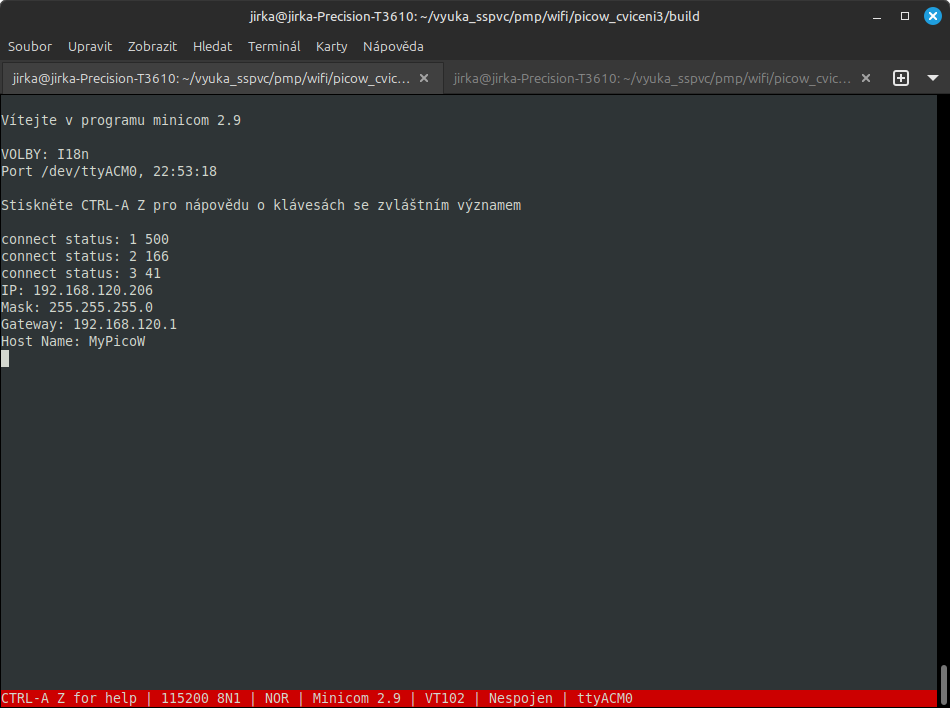
Připojte se minicomem na výstup Pica, je na to 10 sekund od zapnutí.
Testování pomocí minicomu
$ minicom -b 115200 -c on -D /dev/ttyACM0A na výstupu můžete vidět hlášení, minicom je možno ukončit stisknutím kláves Ctrl+a x.
Výsledek
ping na MyPicoW
jirka@jirka-Precision-T3610:~/vyuka_sspvc/pmp/wifi/picow_cviceni3/build$ ping 192.168.120.206
PING 192.168.120.206 (192.168.120.206) 56(84) bytes of data.
64 bytes from 192.168.120.206: icmp_seq=1 ttl=255 time=88.4 ms
64 bytes from 192.168.120.206: icmp_seq=2 ttl=255 time=110 ms
64 bytes from 192.168.120.206: icmp_seq=3 ttl=255 time=132 ms
64 bytes from 192.168.120.206: icmp_seq=4 ttl=255 time=155 ms
64 bytes from 192.168.120.206: icmp_seq=5 ttl=255 time=178 ms
64 bytes from 192.168.120.206: icmp_seq=6 ttl=255 time=200 ms
64 bytes from 192.168.120.206: icmp_seq=7 ttl=255 time=2.91 ms
64 bytes from 192.168.120.206: icmp_seq=8 ttl=255 time=1.91 ms
64 bytes from 192.168.120.206: icmp_seq=9 ttl=255 time=2.21 ms
64 bytes from 192.168.120.206: icmp_seq=10 ttl=255 time=88.0 ms
64 bytes from 192.168.120.206: icmp_seq=11 ttl=255 time=111 ms
64 bytes from 192.168.120.206: icmp_seq=12 ttl=255 time=135 ms
64 bytes from 192.168.120.206: icmp_seq=13 ttl=255 time=157 ms
64 bytes from 192.168.120.206: icmp_seq=14 ttl=255 time=180 ms
64 bytes from 192.168.120.206: icmp_seq=15 ttl=255 time=203 ms
^C
--- 192.168.120.206 ping statistics ---
15 packets transmitted, 15 received, 0% packet loss, time 14015ms
rtt min/avg/max/mdev = 1.912/116.249/203.200/66.666 ms
jirka@jirka-Precision-T3610:~/vyuka_sspvc/pmp/wifi/picow_cviceni3/build$
Je vidět, že to funguje a MyPicoW odpovídá na ping. Rozdíly v časech odpovědí jsou způsobené poměrně slabým signálem AP chorche.